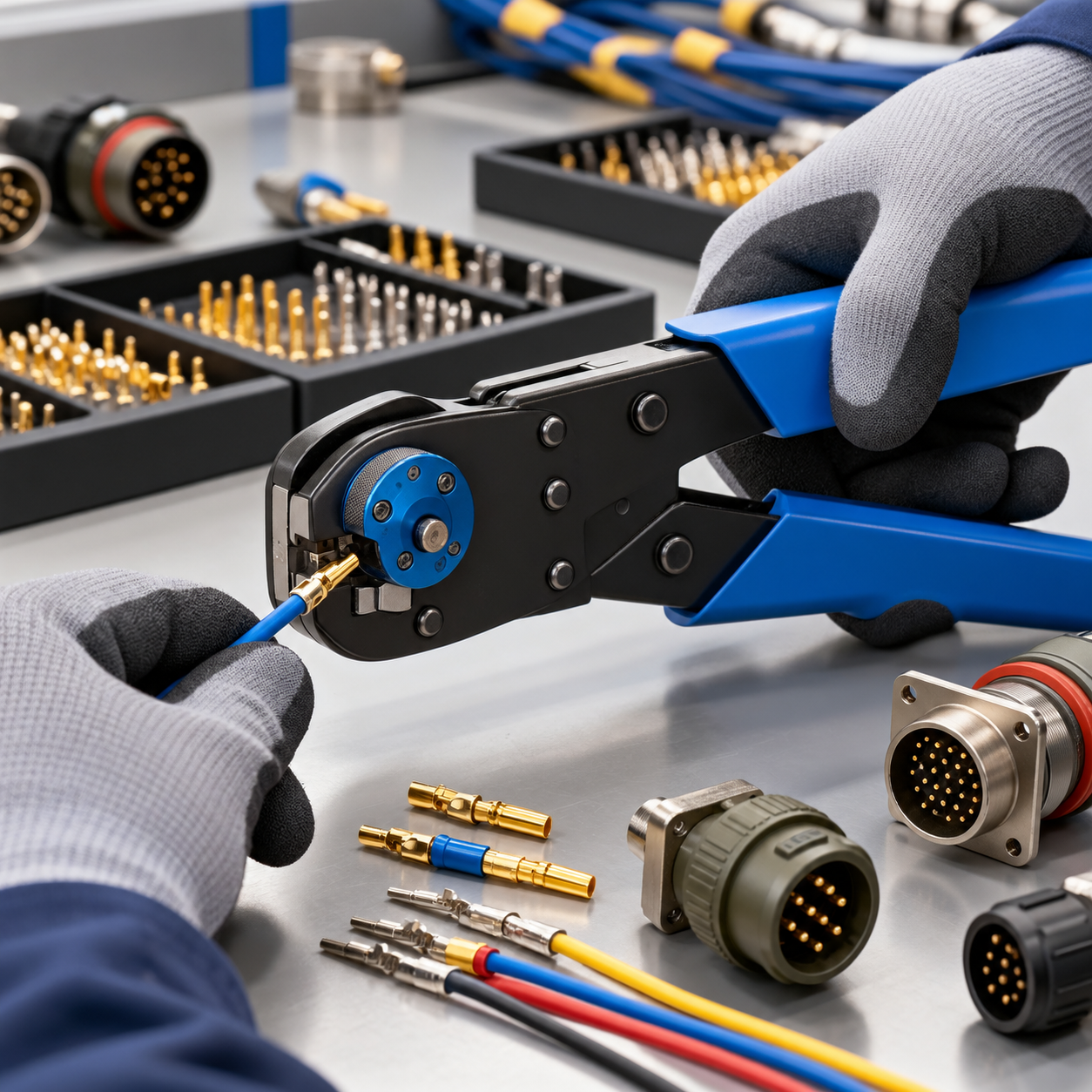
Precision crimping depends on more than the crimp tool itself. In many connector systems, the positioner plays an equally important role because it holds the contact at the correct depth and orientation during the crimping cycle. Using an incorrect positioner can compromise an otherwise carefully controlled termination process.
A DMC Tools Positioner Crimping Tool setup is therefore best selected as a complete application-specific tooling system rather than as an individual hand tool. For harness manufacturers, electrical technicians, aerospace-related workshops, electronics assemblers and maintenance teams in Delhi NCR, matching the positioner to the contact should be one of the first procurement checks.
What Does a Positioner Do in Crimping?
A positioner is designed to locate a compatible contact correctly inside a crimping tool.
This helps ensure that the crimping mechanism acts on the intended part of the contact. Without correct positioning, the contact may sit too high, too low or incorrectly oriented inside the tool.
That can potentially result in:
- Irregular crimp formation
- Damaged contacts
- Incorrect wire retention
- Rejected assemblies
- Additional inspection and rework
- Inconsistent results between operators
The positioner should therefore never be treated as an optional accessory simply because the primary crimp tool can physically close without it.
Start With the Contact Part Number
The safest selection method begins with the electrical contact, not the positioner.
Procurement or engineering teams should first identify:
- Connector manufacturer
- Connector series
- Contact part number
- Wire size being used
- Applicable crimping specification
- Recommended crimp tool
- Recommended positioner or turret configuration
This information creates a traceable tooling requirement.
Visual similarity should not be used to determine compatibility because contacts that look almost identical may require different positioning arrangements.
Positioner Compatibility Matters More Than Brand Familiarity
Buying a DMC tool does not mean every DMC positioner will work with it.
Different tools and connector systems can use different positioners, locators or turret heads. The correct combination needs to be verified against the application documentation.
This is particularly important for industrial buyers who maintain several connector families within the same workshop.
A maintenance department might work with dozens of contact types. Creating a tooling compatibility sheet can prevent technicians from selecting a positioner based only on appearance.
Improve Tool Control in Shared Workshops
Specialised positioners are relatively small components and can easily become misplaced or mixed together.
Workshops can reduce confusion by storing them with clearly identified tooling records.
A practical tool-control system may include:
- Tool identification number
- Positioner part number
- Compatible contact reference
- Crimp tool reference
- Wire range
- Storage location
- Inspection status
This can be particularly useful for contract manufacturers and technical workshops operating multiple assembly stations.
Avoid Common Crimping Mistakes
Even with correctly selected tooling, preparation and operator technique remain important.
Technicians should avoid:
- Guessing selector settings
- Mixing positioners between applications
- Forcing incompatible contacts into the tool
- Using damaged positioning components
- Crimping improperly stripped conductors
- Altering positioners to make contacts fit
- Continuing production when crimp appearance changes
If the crimp result suddenly becomes inconsistent, both the primary tool and positioning system should be checked.
When Is a Business Ready to Procure?
A company is ready to source a DMC Tools Positioner Crimping Tool arrangement when it can provide the connector and contact details rather than simply requesting a general crimper.
This substantially reduces specification errors.
For professional buyers across Delhi, Noida, Gurugram, Faridabad and Ghaziabad, specialised imported tooling should ideally be selected in coordination with engineering or production teams.
Miracle Tools And Tackle LLP supplies professional industrial and electrical tooling to buyers in Delhi NCR. When sourcing DMC equipment, providing the exact contact and connector application can make the product-selection process far more accurate.
In precision crimping, the smallest tooling component can have an important function. Correct positioning helps create the controlled, repeatable process that professional connector assembly demands.
Keywords